For women over 40 who just met their four numbersFor men over 40 who just met their four numbersFor people over 40 who just met their four numbers
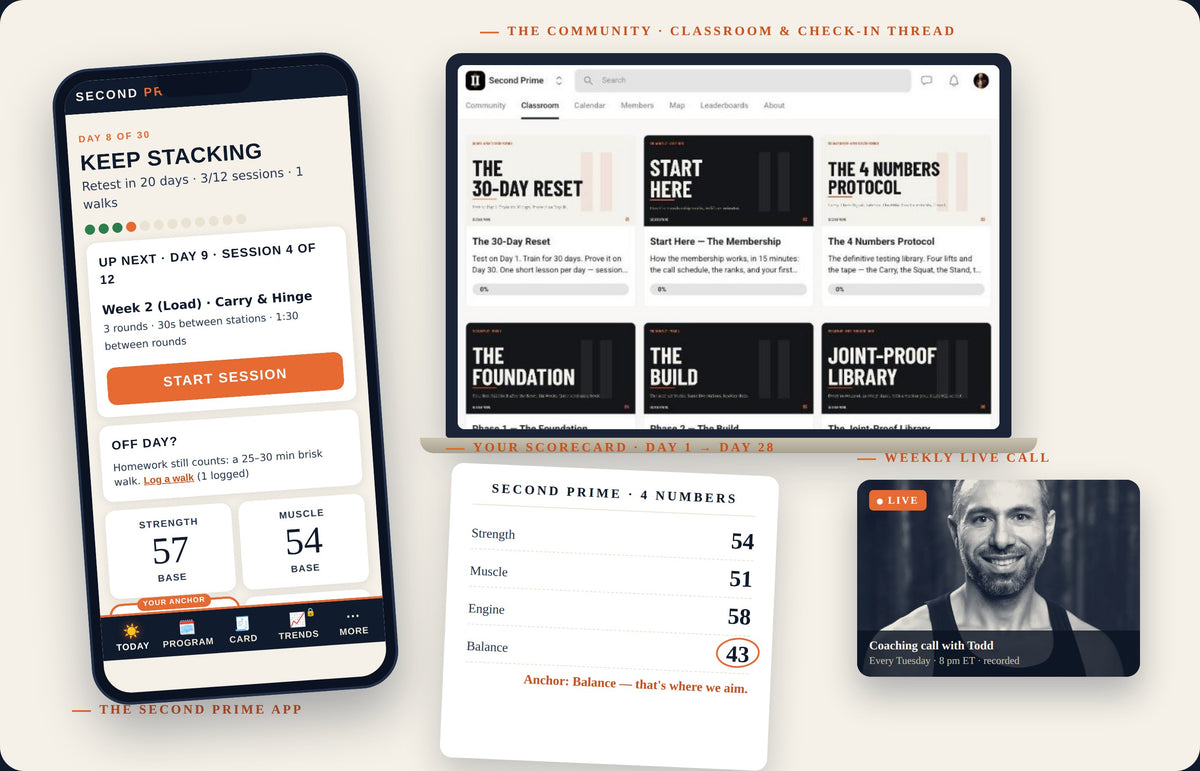
The 30-Day Reset is built on a scoreboard that can't be flattered, fooled, or talked out of its opinion. You test on Day 1. You train three short, joint-aware sessions a week. You retest on Day 28. Either your numbers move, or every dollar comes back.
Same tests, same floor, four weeks apart. (Illustrative example — your card will be in your own handwriting.)
A few minutes ago, or a few days ago if life got in the way, you watched four numbers come back, and one of them sat lower than the rest.
Yours was .You already know the one. It's the one you've reread twice.
It probably didn't shock you. That's the part worth sitting with. Somewhere underneath the surprise there was a quieter reaction, closer to recognition: yes. That one. I've felt that one.
Good. Hold onto it. Because that number isn't sitting still.
After 40, all four of those capacities (Strength, Muscle, Engine, Balance) are moving every week of your life. Untrained, they move in exactly one direction. The researchers who study this put untrained muscle loss somewhere between three and eight percent per decade, and it doesn't fall the way a leaf falls. It drips. Through ordinary weeks. Weeks that feel precisely like this one: busy, fine, unremarkable, nothing wrong.
That's why nobody catches it. You don't feel a number drop. You feel a year where the stairs got a little longer, and then another year where you started using the handrail without deciding to, and then a year where you stopped carrying both bags in one trip, and then a year where somebody younger reached for the other end of the dresser before you did. Not one of those years announced itself. You were never given a moment to object.
Call it Drift.
Drift is patient, it's quiet, it has never once been in a hurry, and it is the single most expensive thing happening in your body right now. It bills you in increments too small to notice and collects in a lump sum sometime in your seventies.
Illustrative pattern, not a measurement: untrained adults lose 3–8% of muscle per decade after 30, and strength falls roughly twice as fast as size.
Before you read another line, know this: that lowest number is not a verdict on you. It's a measurement of one capacity, taken on one ordinary day, on a body that has spent years being graded on the wrong test entirely.
And it is the most trainable thing on your card.
Your scale tells you what you weigh. That's real information, and it isn't nothing.
Your mirror tells you how you look. Also real. Also not nothing.
Your annual physical tells you your blood pressure, your cholesterol, your A1C. Important numbers, taken by someone who went to school for a long time to read them correctly.
But run down that list and notice what's missing. None of them answers the question that decides how the next thirty years go:
Lift, carry, climb, recover, catch itself on a bad step in a dark parking lot. That question has never been on the form.
Nobody was hiding this from you. Those instruments measure something different, and they measure it well. They just can't see this. A scale can't tell ten pounds of muscle from ten pounds of anything else. A mirror has never once reported on your balance. And your physical, for all its precision, has no line for can this person carry their own suitcase up a flight of stairs.
So the thing that was draining went unmeasured. For years.
That's not your failure. You can't train what nobody handed you a number for.
Each of your four numbers is scored out of 100 against your own age band and sex. Add them together and you get your Prime Score, out of 400.
Four links. One chain. The thin one is where your body gives first — and where the Reset starts.
And right now one of those four is lower than the rest, in a way that makes it the thing your body runs into first. On your scorecard it's the one marked Start here. We call it your Anchor.
Three reasons it's where we start, and none of them are motivational:
It has the most room. A 48 has more range in front of it than a 71. You get more back per unit of effort at the bottom of the scale than at the top.
It adapts fastest. This is the least intuitive part and the most useful. An untrained capacity responds much more quickly than a well-trained one. A body that hasn't asked something of itself in years hasn't run out of adaptation. It hasn't been asked. Balance and strength in particular respond in weeks, not seasons, because early gains are largely your nervous system relearning to use the muscle you already have. That's exactly why thirty days is enough to prove something.
It's what stops you. Nobody was ever prevented from standing up by the average of four numbers. You're stopped by the lowest one.
Raise your Anchor and the whole chain advances. Then the constraint moves, and you go after the next one.
Test. Find your Anchor. Train it. Retest. Find the next one.
Every program you've tried had a finish line, which is a polite way of saying it had an expiration date. This one hands you a new objective every time you clear the last one.
Why this exists

My name is Todd. I'm 48 as I write this, and I've been lifting for more than thirty years. Once upon a time I squatted 730 pounds. I mention it only for what it taught me: strength is never something you have. It's something you keep. Or don't.
My mom kept hers for most of her life. She was the athletic one. She kept a garden that took up half the backyard, ran her house like a drill sergeant, and carried groceries up the porch steps two bags at a time. Energetic. Resilient. The last person anyone worried about.
Then the ailments came, the ordinary ones that come for everybody. The advice that came with them never changed: rest. Take it easy. Don't push it. Her doctors said it, everyone around her nodded along, and she listened.
Nothing dramatic happened. That's the point. There was no fall and no single bad day. The garden shrank to a few pots on the porch, then to nothing. Housework she used to finish in a morning stretched across the week, then quietly became someone else's job. The second grocery bag started waiting in the car until someone came by. Each step down was small enough to explain away. Her muscle went first, then her strength, then her bones. Week after week, a little at a time, Drift did what Drift does.
Today my mom hardly leaves her home.
I'm not telling you this for sympathy. I'm telling you because I watched a strong woman lose everything that made her independent, and none of it had to happen. Rest was the wrong prescription. Muscle was the medicine, and nobody wrote it.
So I built Second Prime around what her story was missing: a scoreboard. Four numbers (Strength, Muscle, Engine, Balance), tested at home and retested on schedule, so Drift can't hide behind "I'm fine" anymore. You can't argue with a number moving the wrong way. And you can't fake one moving the right way.
Decades of heavy lifting taught me the other half of the lesson too: how to train smart. Every movement in this program has a joint-friendly version, because the goal was never a 730-pound squat. The goal is carrying your own groceries at 80.
I'm running the same tests you are. My Day-1 card goes up in the community next to yours and gets retested on the same schedule. This brand asks nothing of you it doesn't ask of me first.
Todd · Founder, Second Prime

Untrained, all four capacities decline with age: muscle at roughly 3 to 8 percent per decade, with strength and power falling faster than muscle mass itself. This is among the best-documented findings in the field.
Which means: your lowest number isn't a label. It's a live gauge, and anything live can be steered.
Progressive resistance training produces measurable gains at every age that's been studied, including in people well past 80. There is no age at which the body stops answering.
Which means: "too late" is not your situation. It isn't anyone's.
Not long enough to remake you. Long enough to move a number, especially your lowest one, where early gains are largely neurological and arrive before anything visible does. You will very likely be measurably better at something before you look any different at all.
Which means: you don't have to take anyone's word for whether this worked. You'll have the paper.
Every movement ships with a joint-aware version for knees, shoulders and back, in-line, not in an appendix. The program was built assuming a 40-plus body with a history.
Which means: the twinge that ended your last program has a lane here.
This is the honest answer to "why didn't the last one work." It wasn't willpower. Nothing measured you, and nobody noticed whether you showed up.
Which means: the version of you who quietly stops in week two gets noticed, and pulled back in.


Illustrative — the moment the Reset is built to change.
Day 28, same floor, phone timer running. You stand on one leg, close your eyes, and the count runs past the number that bothered you a month ago. You set the pen down next to two cards, four weeks apart, and they disagree with each other in your favor. The first objective evidence in possibly a decade that you're heading the other way.
Three sessions a week, about thirty minutes each, and you never have to decide what to do. The program is already aimed at your Anchor. You open today's session in the Second Prime app and follow it. No more standing in a gym running a cost-benefit analysis you're not qualified to run.
Two lines in the check-in thread after each session: what you did, what felt strong. That's the whole obligation. It takes forty seconds, and it's the habit that separates people still training a year from now from everyone else.
Somewhere in week three, you reach for something heavy and your body answers faster than you expected. Nobody sees it. There's no photo of it. You just know something you didn't know a month ago.
The version of you who carries their own suitcase at 75. Who says yes to the hike instead of finding a reason. Whose kids argue about where to go on vacation, not about who takes you in. That's the product. The thirty days is how you find out it's within reach.
One honest note, mentioned once and then dropped: people generally do like how they look after a few months of this. That's a side effect. It isn't the scoreboard, and if it's the main thing you want, the next section is for you.
I'd rather say so now than refund you later.
If you want a thirty-day scale transformation, this isn't it. We don't grade on the scale. You may well lose weight. We're not going to promise it, measure it, or celebrate it.
If you want a program that grades itself, this will be uncomfortable. Most programs let you decide whether they worked. This one hands the verdict to a test.
If you won't do the testing, don't buy. The tests take about twenty minutes on Day 1 and twenty minutes on Day 28. Without them, you've bought workouts, and there are free workouts everywhere.
Plainly, here's everything you get.

Completing your scorecard unlocked the quiz-taker rate. When the timer ends, the regular price applies — really.
today, and your first 30 days in the membership are included. From Day 31 the membership continues at $79/month. Cancel any time before then from your account and you won't be charged again. The Reset is yours to keep either way.
Why both, in one purchase. We're asking you to run thirty days and then decide, and we'd rather be judged on that than on anything written on this page. Record your numbers. Do the work. Retest on Day 28. Then decide whether we've earned the right to keep you.
You're probably wondering why it's this cheap. Two reasons. The Reset is where we earn the right to keep coaching you; someone who watches a number move usually wants to keep it moving, and that, not the price, is the business. And we'd rather you spend your skepticism on the retest than on the price.
Day 28, same floor, same phone timer. Put your two cards side by side, your handwriting, four weeks apart. If they don't disagree in your favor, or if you simply don't like us, send one email by Day 30, counted from the day you order, and every dollar comes back. No forms, no phone call, no "are you sure."
Your refund closes out your membership and your Second Prime access in the same step, so the $79 is never charged. If the Reset didn't earn your trust, we're not going to bill you for what comes after it.
You're the judge. We're just the ones who agreed to be graded.
today · $79/month from Day 31 · cancel before then and you won't be charged
Complete the order and your invite to the Second Prime community arrives by email. Take your Day-1 test within 48 hours of ordering; that puts your Day-28 retest comfortably inside your guarantee window.
The terms, stated plainly, because you should never be surprised by a charge:


Illustrative — the moment the Reset is built to change.
One of them ran the tests, did twelve unglamorous workouts in their living room, and is looking at a higher number in their own handwriting, with the next thirty years quietly renegotiated in their favor.
The other one decided this was a later thing. Perfectly reasonable. Nothing bad happened. The card still says today's numbers.
Except it doesn't, because Drift didn't pause while they decided.
Same month either way. The only question is which column it lands in.
The quiz-taker rate is tied to your scorecard window, and when the timer ends it genuinely ends. The button will take you to the same Reset at the regular price, and no amount of refreshing brings the old price back. We don't do fake countdowns. The entire brand is built on numbers that mean what they say, and that includes this one.
Thirty days. Three short sessions a week. Forty seconds of typing after each one. A room that notices whether you showed up.
And at the end of it: your own retest, Strength, Muscle, Engine, Balance, and a number that used to be your Anchor sitting higher than it did the day you first met it.
The number you reread twice. Higher. In your handwriting.
Strong enough that nobody ever has to lower their voice around your health.Be the 60-year-old the 30-year-olds call when something's heavy.Strong enough that nobody ever has to lower their voice around your health.
Test on Day 1. Retest on Day 28. Either the numbers move, or every dollar comes back.
Your order confirmation, then an invite to the Second Prime community on Skool. Accept it and the Reset is waiting inside, starting with the Day-1 test guide. You can be set up tonight and test tomorrow morning.
The True Beginner track assumes exactly that. And Day 1 isn't a workout. It's a measurement. You're not being asked to perform; you're being asked to set a starting line.
Every movement has a joint-aware version in-line, on the same screen, not buried in an appendix. You should never skip a session because one exercise doesn't fit your body.
Three sessions of about 30 minutes, plus a five-minute daily lesson. The tests take about twenty minutes on Day 1 and Day 28.
A tape measure, a phone timer, and a pair of dumbbells (adjustable, or a light, medium and heavy pair). No dumbbells yet? Every loaded exercise has a household version — a loaded backpack, two grocery bags, a jug — and the first two weeks work fine that way. No gym.
Your membership continues at $79/month, counted from the day you ordered. If you don't want to continue, cancel from your account before then and you're never charged again; the Reset stays yours. If you claim the guarantee instead, your refund closes out your membership and your access, and the $79 is never charged.
After the first 30 days, yes. Today you pay for the Reset, and your first month in the membership is included. On Day 31 the membership renews at $79/month unless you cancel.
The billing date doesn't move, but you'd be skipping the entire point. The retest is the product, not a formality.
Second Prime provides fitness education and coaching; it does not provide medical advice, diagnosis, or treatment. Consult your physician before beginning any exercise program. References to research describe general population findings, not predictions about any individual. Individual results vary; the guarantee exists precisely because they do.